

THE COMPOST
- 2 déc. 2013
- 6 min de lecture
What ?
Composting, as you may already know, is the action of making with organic matter such as dead leaves, manure or fruit and vegetables peeling, that has been digested by micro-organisms a mixture that you can use as a soil fertilizer.
This mixture, once it’s ready, you use it on soils in order to improve its quality and that way, what you have planted is growing better. It’s very simple to do. Every organic matter that you have, you collect it, you put it afterwards in a special container (preferably outside) and you wait around 6 months (it can be more or less depending on the seasons so it’s approximately 6 months.) and TADAM: it’s ready. You can use it then on your own garden or plants if you have some, otherwise, I’m sure that it’s super easy to find places or people interested in that.
Why ?
But why bother ?” I don’t have a garden, neither have my friends, my plastic plant is perfect.” Yep, I hear you, but you know, most of our domestic waste is burned which produce greenhouse gases. To reduce these gases there isn’t many solutions. The easiest one is to reduce our domestic waste. With the compost you can do that. Isn’t that great ? And it’s not really complicated right ? You just put day after day in a container like your fruit peeling for example etc. There’s a lot of different types of compost. In some you can put your egg shells, in other not, in some you put your coffee ground etc. It’s really for every one of us. The easiest compost is the one where you put everything in it. (I mean there isn’t any rules but it’s really depending on your knowledge. If you’re like me and this is a brave new world, well, just put everything in it.) Everything : egg shells, vegetables peelings, coffee ground, but also the rest of your meal, meat (expect if the quantities are big, but small portions from time to time are ok), tissues…
How does it work ? In your home you have what we call a “Bio-bucket” it looks like a normal square bucket but with a lid. You’ll put your organic waste in it and once it’s full, you take it to your own composter or to a collective one. It’s cool don’t you think ?
Otherwise there is another method that exists, more for the person living in a flat and not a house, but not necessarily. You’re free to use the method you like better. It’s called vermicomposting, instead of using the traditional method the degradation is made by microorganism and worms. You only need worms and a big bucket where they can be stored. Then you just put your organic waste and let the worms do their things.
Also, a lot of association about collective composting exist. All around the world. Which is great, because people from different places are doing it too. These association can be helpful, you’re not alone is this brand new process, you can ask questions, meet people with the same expectations as you can have, share this experience which can be very nice.
http://www1.nyc.gov/assets/dsny/zerowaste/residents/nyc-compost-project.shtml Here is one association is Auckland, Australia
https://senshumus.wordpress.com/le-compostage/ this one is in Montreuil, France
Where ?
What is even way cooler is that there is now collective composting spots all over France. Even in Paris, yep, even in the Parisian suburbs, even in Lyon, Nantes etc. I couldn’t find unfortunately any map of all the collective composter available in France nor in Paris, but I’m sure that depending on the city you live in, you will be able to find one.
Here is a map of collective composters in New-York City, USA :
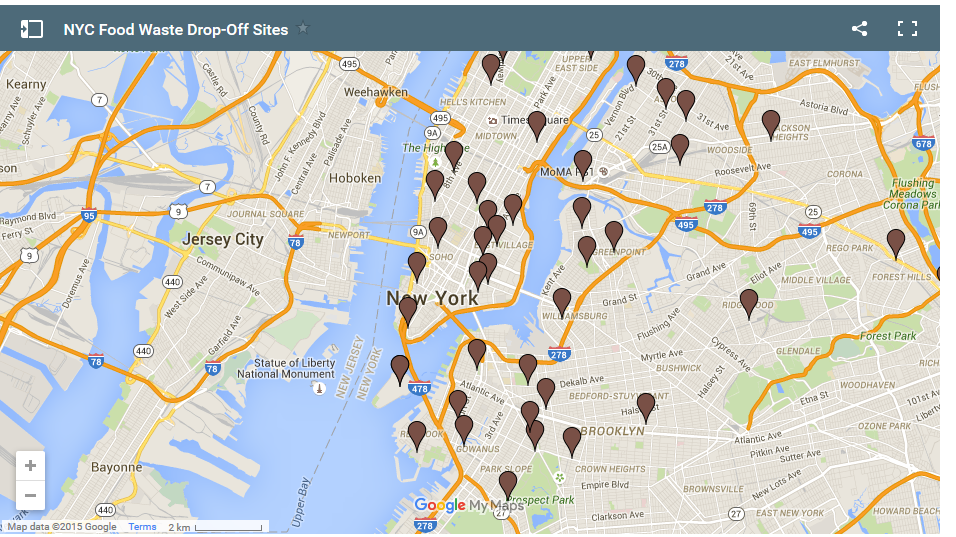
As for the vermicomposting well, you just need to buy the bucket and the worms and then you’re good. If there is no association nearby, Internet and online shopping can be very helpful.
For who ?
Another very good thing about composting is that it’s for everyone. Everyone can participate, at any age, or socio-economic condition. There’s no limit, it’s only up to us now.
Ecologic interest ?
When you know that around 30% of our waste are from organic matter it is kind of big deal, actually, to participate to such actions. It is a new form of ecologic interest I’d say. What is good is that you can actually see the changes and you can have some kind of recognition in your actions, it’s a more direct way of participating. Your compost will then go to collective garden (or your own of course) and from that something will come up, whether it’s plants or vegetables, and it’s nice for once to have something to help build and create.
Interview :

Brunissen Rigaud, 20 Years old, student of Art and litterature at Paris Diderot (Paris 7), Montreuil - I'm making compost since october. I have known about compost since I was a kid, as I was living in the country, and having my father still living there, I am sensitive about this way of collecting waste. It had been a while that I was wondering how to make compost in town. I found a note in the "Tous Montreuil" journal, that indicated a place where to bring our own compost. Indeed, the Sens de l'Humus association in Montreuil has developed different sites (for composting) where people can bring their compost. It's up to Montreuil's citizens to manage this place and take care of it. Therefore every saturday morning, from 11 to 13, we can bring our weekly compost. In exchange, we have to be here one satuday to help. So this is something positive, it is a self-managed place ! The compost that will become loam will be then distributed to collective gardens and other. I think that composting is important, it allows us to rethink the idea of waste itself, and finally there is no waste everything can be renew. It's an other way of consuming too. An other way of managing our consumption. Personally, I think it is part of a sensible approach of human impact, but it's also a way to find an alternative in a society that over consume and therfore over waste. Yes this is accessible to everyone. Everyone can make this : action separating, sorting waste. You just need a bio-bucket, but you can tkel any kind of bucket with a lid, even any kind of container. I think that the association can even lend you one. I bought mine for 5 euros, it exists with many size and content.
Yes, there is smell, it normal from time to time, reactions occur, but since it's natural it's not very annoying. We place the bucket on the balcony. Since we don't eat meat, we consume more fruits and vegetables, the bucket is full quickly. (Add to this that my mother cooks a lot, so the bucket is actually full quite quickly). The advantage is that you have engagement, sensibilization and urban life all together. The drawback is that if we forgot to bring it on saturday morning it would be nice if the association had another opening day, like the wednesday for example. (I also forgot to tell you that I wanted to do vermicomposting first but I didn't find (or take) the time to make the container myself so I chose the bio-bucket. Another advantage : it doesn't take space, it has been think to be in a kitchen.
Negative points :
- If you’re super lazy (like I am…) you will have to move in order to put the content of your bucket in the collective container. Even if it rains Or snows. Or there’s a hurricane (or maybe in this case you can stay home).
- The collective container can be quite far from your house. (But see that as a new opportunity to use your bike and muscle your body, become sexier and healthier…)
Positive points :
- You help indirectly to reduce the greenhouse gases. (Now you can tell your friends that you are a super hero too, like Superman or Batman…)
- You reduce your domestic wastes.
- You participate to a local initiative (when it’s collective composting).
- With the compost created, what you’ll plant will grow better and the soils will have more nutriments and water retention.
Sources :
French sources :
International sources : http://www.lhpowerandlight.org/benefits-of-composting.html
Commentaires